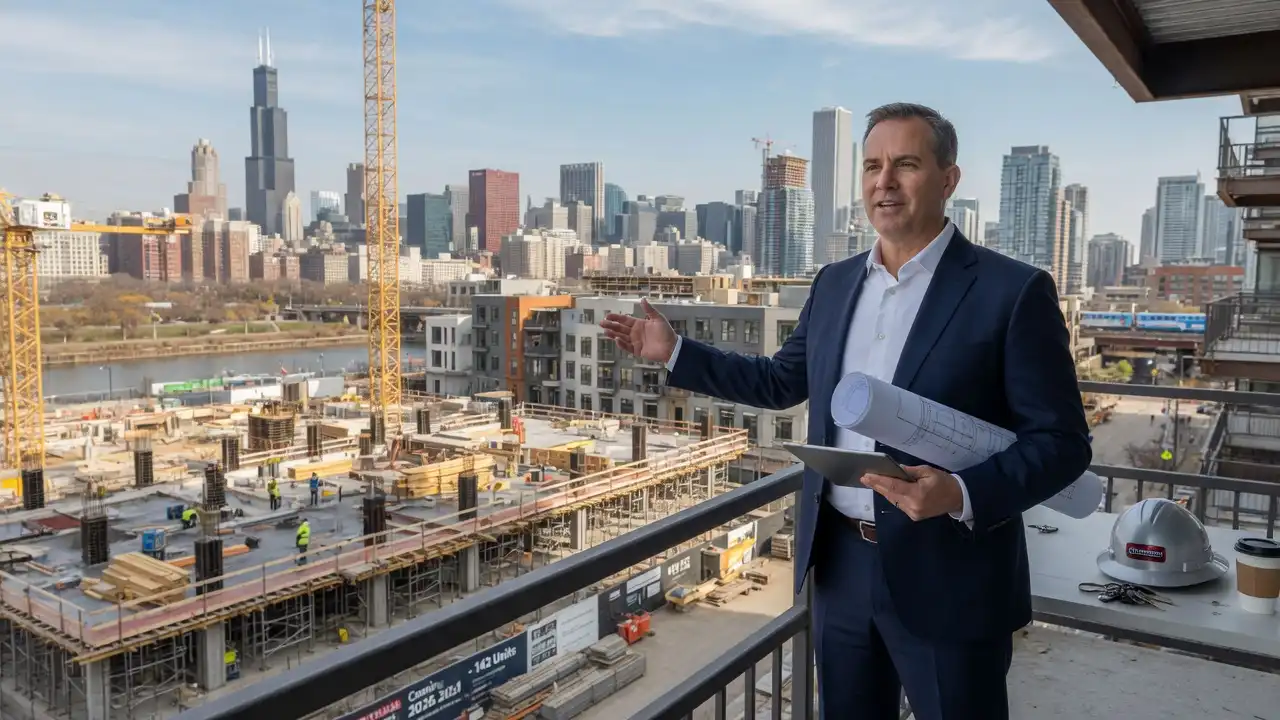
Chicagoland Business Broker: What Builders Must Know
Every quarter, another established Midwest construction firm hits the market and the buyers circling these deals need a chicagoland business broker who understands structural assets, equipment books, and backlog valuations.
If you’ve been following construction technology trends across the Midwest, this won’t come as a surprise.
Rising construction costs, tighter capital underwriting, and infrastructure constraints have slowed speculative starts, pushing seasoned owners toward exits and creating a once-in-a-decade acquisition window.
Key Takeaways
- A qualified chicagoland business broker with construction-sector experience can dramatically shorten your acquisition timeline and protect deal confidentiality.
- SBA financing is a powerful tool for entrepreneurs looking to acquire existing businesses, with flexible structures, longer repayment terms, and lower equity requirements through SBA 7(a) loans.
- Despite increases in material and union labor costs, bid prices in the Chicago market are expected to remain flat in Q1 and Q2 of 2026 due to a limited opportunity pipeline and an abundance of competition.
Why Is the Chicagoland Construction Market Primed for Acquisitions?
Our analysis suggests the current environment is creating a rare alignment of motivated sellers and well-capitalized buyers.
More than $18 billion in major projects are currently underway across Chicago, which means profitable, revenue-generating construction firms are more attractive than they’ve been in years.
The construction industry is entering the second half of 2026 with affordability challenges, persistent labor shortages, cautious buyers, rising expectations, and tighter profit margins.
For owners nearing retirement or facing workforce fatigue, working with a chicagoland business broker offers a structured, confidential exit.
What Does a Chicagoland Business Broker Actually Do for Construction Deals?
A chicagoland business broker does far more than list a company for sale.
Construction industry insiders are noting that deal structure not just price is where most transactions either succeed or collapse.
Working with a specialized broker gives your construction company the best possible representation a certified business broker can help determine a fair valuation and keep the venture confidential, while leveraging marketing skills specific to the industry to find the right buyer quickly.
Here’s what the process typically involves:
Step-by-Step: The Construction Business Acquisition Process
- Initial Valuation & Financial Recasting
Gather three to five years of tax returns, profit-and-loss statements, and balance sheets.
A qualified broker recasts earnings to show the true owner benefit stripping out personal expenses, one-time charges, and non-recurring costs. - Confidential Marketing & Buyer Screening
The broker markets the firm under a blind profile, never revealing the company name until a buyer signs a non-disclosure agreement.
This protects employee morale, client relationships, and competitive positioning. - Buyer Qualification & Financing Alignment
The SBA 7(a) loan term for acquisitions is typically 10 years, which is more favorable than most conventional acquisition financing and meaningfully reduces the monthly debt service burden on the acquiring business.
Your chicagoland business broker should coordinate early with the buyer’s lender to confirm deal feasibility. - Due Diligence Management
Due diligence is “research and analysis of a company or organization done in preparation for a business transaction.”
For construction firms, this includes reviewing bonding capacity, active contracts, lien histories, and equipment condition. - Closing & Transition
Final negotiations, legal review, and a 30-to-90-day transition period where the seller trains the new owner on vendor relationships, estimating systems, and crew management.
How Will Market Conditions Impact Your Next Move?
The numbers tell a clear story.
Our team observed a competitive but navigable landscape for construction acquisitions in the greater Chicago metro.
| Bid Price Movement | Moderate increases | Flat to declining | Favorable for buyers |
| Labor Availability | Strained | Consistent but tight in MEP trades | Increases firm value for staffed companies |
| Material Costs (Steel) | Volatile | Stabilizing (64% of survey respondents) | Reduces margin risk |
| SBA 7(a) Loan Terms | 10-year standard | Unchanged | Supports acquisition financing |
| Construction Employment (IL) | ~240K workers | Modest growth | Tight talent pool favors acquisition over startup |
According to Turner & Townsend’s Chicago Construction Sentiment Survey, 64% of respondents are seeing steel prices stabilize, while 27% say tariffs on copper and steel conduit are driving up electrical costs.
Construction employment in Illinois stood at approximately 239,800 workers as of late 2025, according to the U.S. Bureau of Labor Statistics a figure that underscores how scarce qualified crews have become.
This scarcity is exactly why acquiring an existing firm through a chicagoland business broker often makes more financial sense than building a company from scratch.
What Should Buyers and Sellers Look for in a Broker?
Not every broker is built for construction deals.
Our contractors note that the single biggest mistake sellers make is choosing a generalist who doesn’t understand backlog, work-in-progress accounting, or bonding capacity.
What to verify before signing a listing agreement:
- Make sure the broker is licensed and has the appropriate credentials look for membership in professional organizations such as the International Business Brokers Association (IBBA).
- Ask for a track record specific to construction, contracting, or trades businesses.
- Evaluate their marketing strategy they should be able to explain how they will attract potential buyers and promote your business effectively.
- Confirm they understand SBA deal structure, including seller note requirements, equity injection rules, and standby provisions.
The International Business Brokers Association (IBBA) is a North American professional association operating exclusively for people and firms engaged in business brokerage and mergers and acquisitions, providing education, conferences, professional designations, and networking opportunities.
A chicagoland business broker affiliated with the IBBA carries a credential the Certified Business Intermediary (CBI) that signals real transactional experience.
How Does SBA Financing Shape the Deal?
Financing is where most first-time buyers get stuck.
The SBA 504 loan program offers long-term, fixed-rate financing with competitive terms and low down-payment requirements, with typical structures allowing up to 90% loan-to-value on owner-occupied commercial properties.
For buyers acquiring a construction company that owns its yard, shop, or office space, this structure preserves working capital while securing physical assets.
If you’re ready to grow through acquisition, SBA financing can help you can use funds to purchase another construction business, acquire their equipment, or take over existing client relationships.
Your chicagoland business broker should be able to walk both parties through the financing stack before a letter of intent is even drafted.
The Bottom Line for Midwest Contractors
The companies that thrive will be those that approach 2026 with discipline and strategic focus rather than simply chasing revenue contractors who can control cost exposure, secure and develop their workforce, embrace appropriate technology, and orient toward high-growth segments will be positioned to outperform peers.
Whether you’re looking to sell a 30-year specialty trade firm or buy your way into the Chicagoland market, a chicagoland business broker with construction-sector fluency is the single most important partner in that transaction.
More Info Too Visit Chicagoland Business Broker