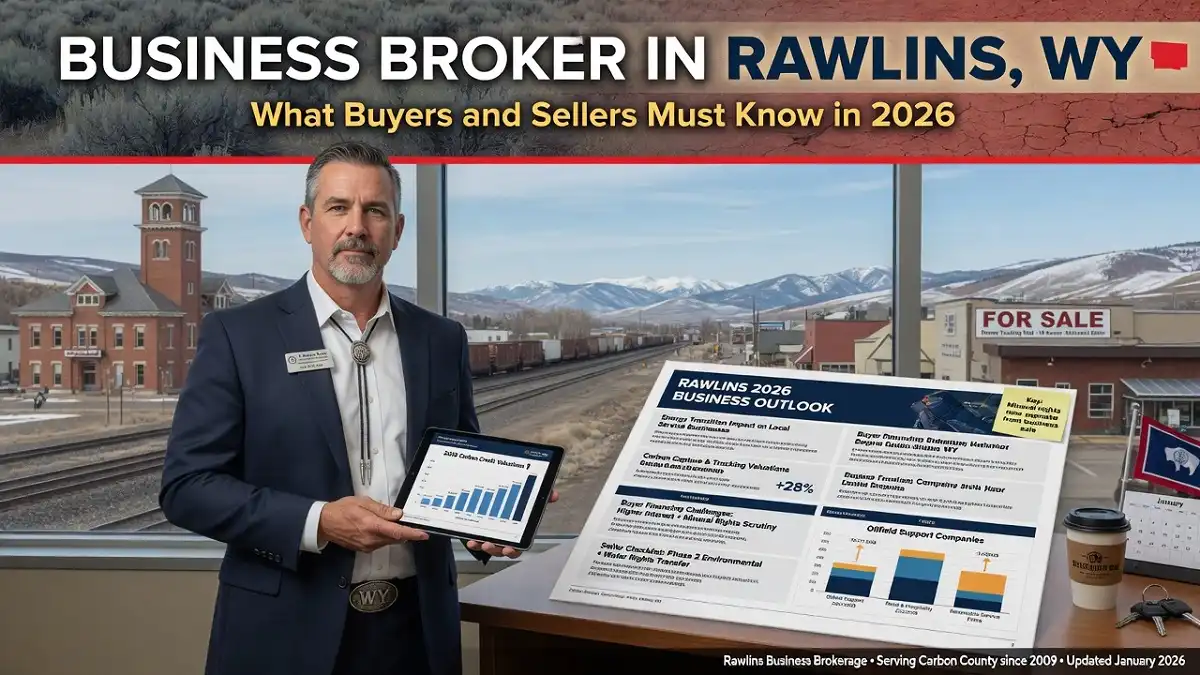
Business Broker in Rawlins, WY: What Buyers and Sellers Must Know in 2026
Selling or buying a business in a small Wyoming market is harder than it looks. Rawlins has a limited pool of qualified buyers, a commercial market that moves slowly, and industry-specific factors tied to energy, ranching, and highway traffic. A skilled business broker in Rawlins helps you price the deal correctly, find serious buyers, and keep the transaction from stalling.
This article breaks down the numbers, the deal structures, and the financing rules you need to understand before you sign anything.
At Chicagoland Business Broker, our team works deals daily across similar mid-market conditions. The mechanics of valuation, financing, and deal structure carry over directly to a market like Rawlins, and the tables below give you the working detail.
Key Takeaways
- Rawlins is a thin market. With roughly 13 active commercial listings as of July 2026, both pricing discipline and buyer sourcing matter more than in a metro market.
- Deal structure drives your after-tax outcome. Asset sales and stock sales carry different tax and liability results, and the right choice depends on your situation.
- Financing shapes what buyers can pay. SBA 7(a) loans up to $5 million support most business acquisitions, and understanding the terms early helps you set a realistic price.
Business Broker in Evanston for Illinois Buyers and Sellers
What a Business Broker in Rawlins Actually Does
A broker is an intermediary. The broker prices the business, prepares confidential marketing materials, screens buyers, and manages the process from listing to closing. In a small market, the buyer-sourcing work carries extra weight because local demand alone is rarely enough.

Here is the core scope of work a business broker in Rawlins performs:
| Function | What It Involves | Why It Matters in Rawlins |
|---|---|---|
| Valuation | On-site review, financial recasting, multiple analysis | Thin comparable data requires careful judgment |
| Confidential marketing | Blind listings, buyer NDAs | Protects your staff and customer relationships |
| Buyer screening | Financial qualification, intent review | Limited local buyer pool means each lead counts |
| Deal structuring | Asset vs. stock, terms, seller financing | Structure affects taxes and closing certainty |
| Closing coordination | Legal, lender, and escrow management | Keeps a slow market deal from falling apart |
Note the difference between a business broker and a commercial real estate agent. Local firms such as ERA Frontier Realty and Coldwell Banker Hewitt Associates handle property transactions in the Rawlins area.
A business sale often includes real estate, but it also includes cash flow, goodwill, equipment, and workforce. Those require business-specific valuation work, not just a property appraisal.
The Rawlins, WY Market Snapshot
Rawlins sits on Interstate 80 in Carbon County. Its economy leans on energy, transportation services, government facilities, ranching, and travel-related retail. The commercial market is small and moves at its own pace.
| Market Factor | Current Condition (July 2026) |
|---|---|
| Active commercial listings | ~13 |
| Primary economic drivers | Energy, ranching, I-80 traffic, government |
| Buyer pool | Limited local demand; often needs out-of-area marketing |
| Typical time to close | Longer than metro markets |
| Business registration | Filed through the Wyoming Business Division (wyobiz.wyo.gov) |
A few practical points shape any Rawlins deal:
- Buyer sourcing often reaches beyond the county. Thirteen active listings signals thin turnover, so relying on walk-in local buyers may extend your timeline.
- Insurance and risk review matter early. Providers like Crest Insurance handle local coverage, and a buyer’s lender will want confirmed policies before closing.
- Wyoming’s business climate is a selling point. No corporate or personal income tax and simple entity filing through the Wyoming Business Division can make an acquisition more attractive to out-of-state buyers.
How to Buy a Gas Station for Sale in Chicago: Valuation, Financing, and Deal Execution in 2026
How Valuation Works: Multiples by Industry
Valuation usually starts with Seller’s Discretionary Earnings (SDE) for smaller owner-operated businesses or EBITDA for larger ones. The broker recasts financials to show true owner benefit, then applies a market multiple.
The multiples below are general small-business ranges. Actual figures depend on cash flow quality, customer concentration, lease terms, and whether real estate is included.
| Industry Type | Typical SDE Multiple | Notes for Rawlins |
|---|---|---|
| Retail / convenience | 1.5x – 2.5x | I-80 traffic can support strong locations |
| Restaurant / hospitality | 1.5x – 2.5x | Depends heavily on lease and location |
| Service businesses | 2.0x – 3.5x | Recurring revenue lifts the multiple |
| Auto / transportation services | 2.5x – 3.5x | Highway corridor demand is a factor |
| Healthcare practices | 2.5x – 4.0x+ | Provider transition and payer mix drive value |
| Energy / industrial services | 2.5x – 4.0x | Contract stability is closely reviewed |
A multiple is a starting point, not a final price. The number you can actually collect depends on how the deal is structured and financed. Our team observed that customer concentration and owner dependence often move a valuation more than the headline multiple does. A business where one customer drives half the revenue carries more risk, and buyers price that risk in.
Asset Sale vs. Stock Sale: Which Structure Fits?
Deal structure affects taxes, liability, and closing certainty. Most small-business sales in a market like Rawlins are asset sales, but the right choice depends on your entity type and goals.
| Factor | Asset Sale | Stock Sale |
|---|---|---|
| What transfers | Selected assets and liabilities | Entire legal entity, including shares |
| Buyer liability exposure | Lower; buyer chooses what to assume | Higher; buyer inherits all liabilities |
| Seller tax treatment | Can trigger higher ordinary income on some assets | Often favorable capital gains treatment |
| Buyer tax treatment | Step-up in asset basis; future depreciation | No step-up; carries existing basis |
| Common preference | Preferred by most buyers | Preferred by most sellers |
| Typical use | Majority of small-business deals | Larger deals or when contracts don’t transfer easily |
The distinction is not cosmetic. Buyers generally prefer asset sales because they limit inherited liability and allow a step-up in basis. Sellers often prefer stock sales for the capital gains treatment. Where the two sides land usually comes down to negotiation and the specific tax picture. This is standard territory for a business broker in Rawlins, working alongside your CPA and attorney.
Financing the Deal: SBA 7(a) Loan Terms
Most acquisitions in this size range use SBA-backed financing. The SBA 7(a) program is the primary route, and it directly funds “changes of ownership,” which is the technical term for a business purchase. You can review the full program details on the SBA 7(a) loans page.
Understanding these terms early helps you set a price a financed buyer can actually meet.
| 7(a) Loan Feature | Detail |
|---|---|
| Maximum loan amount | $5,000,000 |
| Eligible uses | Business acquisition, real estate, equipment, working capital, debt refinancing |
| Loan guarantee | 85% for loans of $150,000 or less; 75% above $150,000 |
| Application route | Through participating SBA lenders, not the SBA directly |
| Core eligibility | Operating for-profit U.S. business, creditworthy, able to repay |
| Repayment | Monthly principal and interest from business cash flow |
A few points for buyers and sellers to keep in mind:
- Lenders underwrite cash flow, not just the asking price. If the recast earnings do not support the debt payment, the loan will not clear at your target price.
- The buyer works with the lender directly. The SBA guarantees the loan; it does not issue it. SBA’s Lender Match tool connects buyers with participating lenders.
- Clean financials speed approval. Sellers who keep accurate, current statements reduce the risk of a financing delay.
Buyer vs. Seller Responsibilities
A clean deal depends on both sides doing their part. When responsibilities blur, timelines slip. Here is how the work typically divides.
| Stage | Seller Responsibility | Buyer Responsibility |
|---|---|---|
| Preparation | Organize financials, leases, contracts | Confirm financing pre-qualification |
| Valuation | Provide accurate records for recasting | Review and validate earnings quality |
| Due diligence | Disclose liabilities, legal, and tax items | Verify assets, contracts, and permits |
| Financing | Support lender document requests | Complete loan application and underwriting |
| Closing | Deliver clean title and transfer assets | Fund down payment and sign loan documents |
| Transition | Provide agreed training period | Retain key staff and customers |
The transition period is where many deals earn or lose their value. A seller who commits to a real training window helps the buyer keep customers and staff. That continuity protects the price both sides agreed to.
How Tenant Rights When Landlord Sells Property Impact Business Deals in Chicagoland
Common Mistakes to Avoid
Our team sees the same avoidable errors across markets, and they apply directly to Rawlins:
- Pricing on hope instead of cash flow. A high multiple means nothing if a lender’s underwriting cannot support it.
- Skipping confidential marketing. Announcing a sale too early can unsettle staff and customers. Blind listings and NDAs help protect the business.
- Waiting to organize financials. Disorganized records slow due diligence and can kill financing. Start early.
- Ignoring deal structure until the end. Asset versus stock treatment should be discussed before you agree on price, not after.
- Underestimating buyer sourcing in a thin market. With around 13 active listings, local demand alone may not produce a qualified buyer.
How to Prepare for a Sale: A Practical Checklist
If you are considering a sale, these steps put you in a stronger position:
- Assemble three years of financial statements and tax returns.
- Document recurring revenue, customer concentration, and key contracts.
- Confirm your lease terms and any transferability conditions.
- Review entity standing through the Wyoming Business Division at wyobiz.wyo.gov.
- Get a realistic valuation before setting an asking price.
- Discuss deal structure with your CPA and attorney.
For buyers, the mirror-image work matters just as much: secure financing pre-qualification, verify the earnings quality, and confirm what transfers with the business.
Finding the Right Broker
A qualified intermediary should demonstrate real transaction experience, not just a license. The International Business Brokers Association (IBBA) maintains a member directory and the Certified Business Intermediary (CBI) designation, which signals education and ethics standards. You can search the IBBA member directory to review credentials.
When you evaluate a business broker in Rawlins, ask direct questions:
- How do you value a business in a thin market?
- How will you source buyers beyond the local pool?
- How do you protect confidentiality during marketing?
- What is your experience with SBA-financed acquisitions?
The answers tell you whether the broker understands the specific conditions a Rawlins deal presents.
The Bottom Line
A Rawlins business sale succeeds when the price reflects real cash flow, the structure fits both sides, and the financing is realistic from day one. A capable business broker in Rawlins manages valuation, confidential marketing, buyer sourcing, and closing so the deal does not stall in a slow market. The tables above give you the working numbers to start that conversation with confidence.
At Chicagoland Business Broker, we apply the same disciplined process to mid-market deals every day. If you are weighing a sale or an acquisition, tell us where the business stands, what the financials show, and what you want the outcome to be. We will help you map a realistic path from there.