How Land for Sale in Chicago Area Prices Set Business Deal Value
Land for sale in Chicago area is no longer a side lot on a listing sheet. It is the basis of the deal. A clinic pad, a warehouse site, or a tear-down corner can move price, financing, and closing risk more than the operating business on top of it. At Chicagoland Business Broker, our hands-on deal analysis across Cook, DuPage, Lake, and McHenry treats the dirt as a separate asset, then ties it back to the going concern.
Key takeaways
- Price the land first. Mid-2026 bands run from outer transitional acres to $250,000 to $500,000 per acre on established industrial land near O’Hare.
- SBA will not fund a speculative land bet. Owner-user buildings can use 504 financing. Raw land held for resale cannot.
- Cook County tax math is different. Commercial and industrial land is assessed at 25% of market value, not the 10% residential ratio.
Check Also: The Strategic Role of 2300 Lincoln Park West Chicago IL 60614 for Illinois Business Buyers and Sellers
Mid-2026 Market Snapshot
Chicagoland dealmakers are noting a split tape. Infill pads with utilities stay scarce. Large outer tracts reprice only when power, access, and zoning line up. Industrial occupancy still supports new sites. Cushman & Wakefield reported Chicago industrial vacancy at 4.8% in Q2 2026, with positive year-to-date absorption and a large construction pipeline.
That occupancy does not mean every acre clears. Spec buildings in softer pockets sit. Build-to-suit and owner-user land still trades. If you have been tracking Illinois business sales, this split will not surprise you. Operators buy land for sale in Chicago area corridors when the building they need does not exist.
Observed asking and trade bands, October 2026
| Product | Typical band | Where it shows up | What moves the number |
| City infill lot | $80,000 to $800,000+ | Chicago neighborhoods, tear-downs | Block, alley, zoning, lot width |
| Suburban home site | $50,000 to $400,000 | DuPage, Lake, McHenry infill | School path, sewer, tree cover |
| Commercial pad | $400,000 to $1.5M per acre | DuPage corners, near-north Cook | Frontage, traffic, utilities |
| Industrial, O’Hare belt | $250,000 to $500,000 per acre | Elk Grove, Bensenville, Des Plaines | Truck access, power, clear height path |
| Lake / McHenry industrial | $80,000 to $300,000 per acre | I-94, I-90, county corridors | Municipality, wetlands, users nearby |
| Ag / transitional | $15,000 to $60,000 per acre | Outer collar, before entitlement | Tillable soils, no power path yet |
| Power-ready large tract | Several times ag value | Will, Grundy, far west paths | Transmission, zoning, water |
Bands are observed ranges from mid-2026 trades and listings. They are not an appraisal. Confirm every parcel.
County Deal Map
Our team observed four different markets inside one metro. Cook is tax-heavy and entitlement-heavy. DuPage is pad-scarce. Lake mixes North Shore pricing with value corridors. McHenry still offers land basis if utilities are real.
| Factor | Cook | DuPage | Lake | McHenry |
| Best buyer use | Urban infill, industrial, clinics | Pads, medical, light industrial | Corridor industrial, estate lots | Yard, flex, larger sites |
| Land scarcity | High inside the city | Very high on corners | Mixed by town | Lower, site-specific |
| Tax loading | 25% commercial assessment | Township assessor, lower ratio | Township assessor | Township assessor |
| Incentive path | Class 6b, 7a/7b, 7c, 8 | Local TIF, limited | Municipal, select | Municipal, select |
| Typical risk | Zoning, environmental, taxes | Price, stormwater | Wetlands, septic vs sewer | Utilities, absorption |
| Days to contract | 45 to 120 on clean sites | 30 to 90 if priced | 45 to 120 | 60 to 150 |
Timing assumes a clean title, a responsive seller, and no wetland redo. Assemblages take longer.
Cook County
City lots fail on width, alley access, and landmark rules more often than on price. A 25-foot lot and a 30-foot lot are not the same product. South and west side industrial land can look cheap until environmental history and truck routes are priced. Near O’Hare, buyers pay for the last usable acre, not for acreage.
DuPage County
DuPage corners still clear when the pad is utility-served and signalized. A one-acre industrial lot in the Bensenville and Elk Grove belt can ask near $900,000 when zoning and utilities are in place. Soft asking prices usually mean stormwater, access, or a house that must come down.
Lake and McHenry Counties
Lake County land splits by town. Corridor industrial near I-94 is a user market. Estate lots follow school and lake demand. McHenry rewards buyers who confirm sewer, water, and road weight limits before they model rent. Cheap acres without utilities are not cheap.
Check Also: The Strategic Role of 400 E South Water Chicago IL for Illinois Business Buyers and Sellers
What sets land value
We price land for sale in Chicago area deals on use, not on the seller’s last tax bill. Six items decide whether a site belongs in a business sale or should be carved out.
| Driver | Why it matters | Fail signal |
| Zoning and use | Controls what can be built or occupied | Special use required, no timeline |
| Utilities | Sewer and power set build cost | Well, septic, or long ComEd wait |
| Access | Trucks, patients, and customers must enter | No curb cut, weight limit, no signal |
| Shape and coverage | Odd parcels waste FAR and parking | Flag lot, floodplain, easement wall |
| Environmental | Phase I and II can kill leverage | Dry cleaner, fill, underground tanks |
| Taxes and incentives | Carry cost after closing | No class relief, high vacant rate |
| Power capacity | Data, cold storage, medical imaging | No path inside 24 months |
| Exit liquidity | Who buys it if the user walks | One-user zoning, no comps |
Industrial, Logistics, and Power-Ready Sites
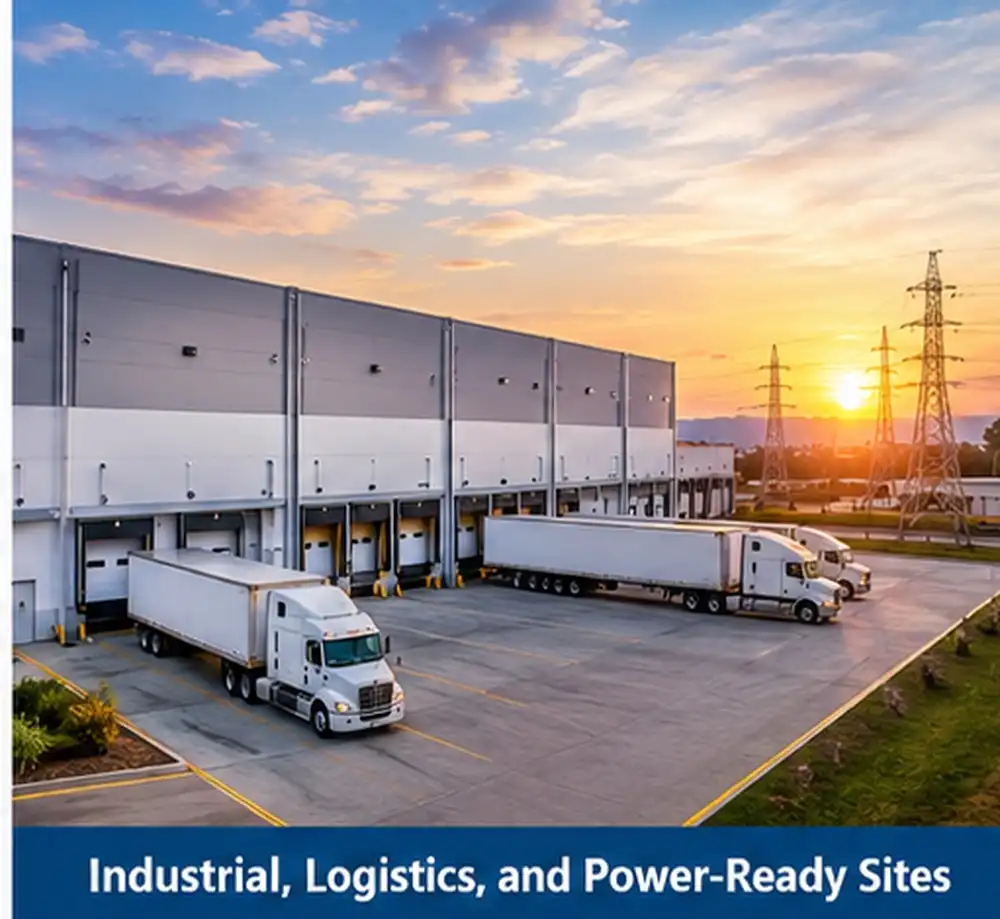
Q2 2026 industrial stats explain why land still bids. Vacancy is tight in several collars and softer where spec delivered. Asking rents support new owner-user buildings more than they support a vacant land hold.
| Submarket read, Q2 2026 | Vacancy context | Rent context | Land read |
| Chicago industrial, metro | About 4.8% (Cushman) | Positive YTD absorption | User sites still clear |
| O’Hare belt | Mid-single to high-single digits | Highest NNN rents in the set | $250k to $500k per acre |
| West suburbs | Tighter, near 2% in some sets | Strong direct rents | Pads scarce |
| Lake County industrial | Roughly 4.7% to 6.8% | Mid-tier NNN | Selective, access-driven |
| McHenry County industrial | Roughly 4.4% direct area | Lower rent, tighter stock | Basis works if utilities exist |
| Central Kane and DuPage | Softer, up to about 8% | Mixed absorption | Do not pay O’Hare prices |
| Outer power tracts | Not an occupancy stat | Data center underwriting | Ag price is the wrong comp |
Vacancy and rent figures draw on Q2 2026 Chicago industrial reporting, including Cushman & Wakefield and CBRE submarket tables. Confirm the current quarter before you bid.
Power is the new zoning on large tracts. Farmland that traded at $15,000 to $60,000 an acre is being underwritten by data center sponsors when transmission is real. A 2026 Morris-area trade near $150,000 an acre on a zoned, transmission-backed tract shows the gap. Joliet’s large campus annexation is the same story at city scale. Most small business buyers should ignore that tape unless the parcel has a documented power path.
Infill Lots, Pads, and Healthcare Sites
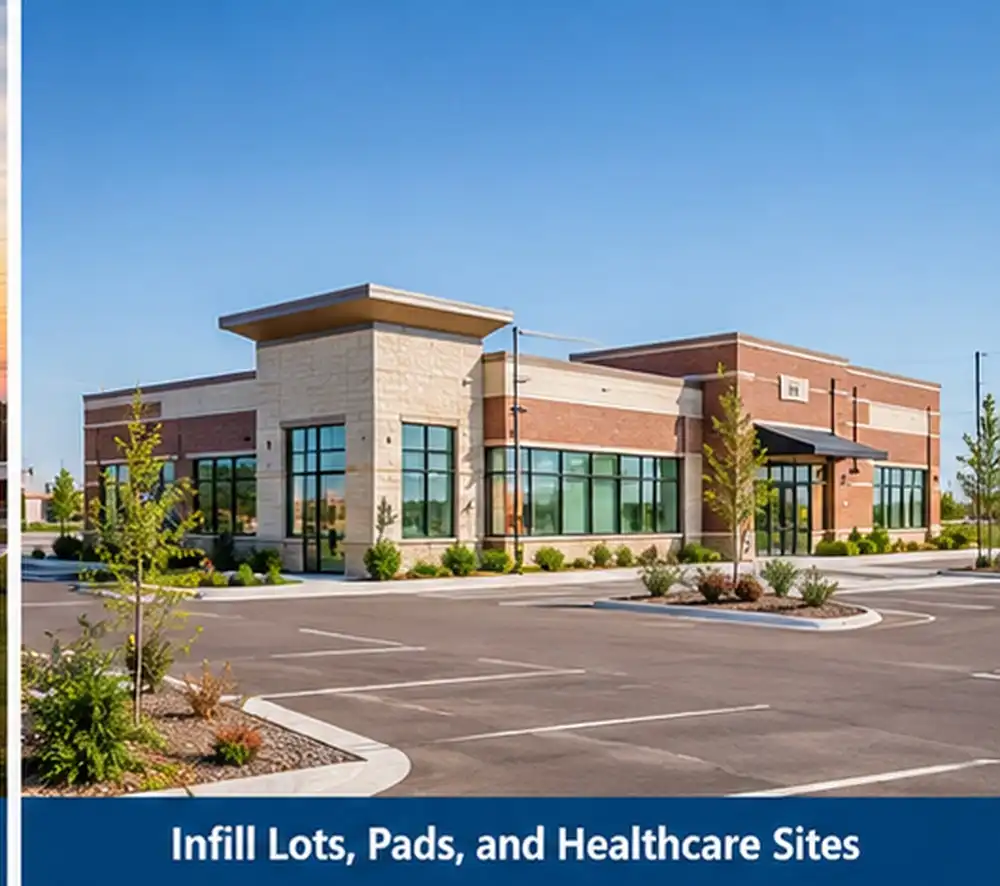
Our healthcare practice work, spanning 25-plus years of clinic and professional sales, keeps running into the same land test. A dental, urgent care, or medical office user needs parking, visibility, and a certificate path, not just acreage. We pair that with licensed real estate work so the practice sale and the site close on one timeline.
| User | Site that works | Size cue | Watch item |
| Dental or medical office | Signalized pad, sewer | 0.6 to 2.5 acres | Parking ratio, condo docs |
| Urgent care | Ingress on a retail road | 1 to 2 acres | Exclusive use, sign rights |
| Veterinary | Separated entrance | 0.75 to 2 acres | Outdoor run rules |
| Light manufacturing | Industrial zoning, dock path | 1 to 5 acres | Outside storage limits |
| Contractor yard | M or I zoning, heavy access | 1 to 8 acres | Screening, stormwater |
| Mixed-use infill | Planned development path | Lot by lot | Neighborhood notice, FAR |
Residential lots still matter to business owners who want a live-work or tear-down hold. They should not be valued like a commercial pad. School path and lot width set the house site. Traffic counts set the pad. Mixing those comps is how sellers overprice land for sale in Chicago area listings.
Buyer and Seller Roles
A land file dies when each side waits on the other. We assign tasks in the first week. Sellers own the paper.

Buyers own the use test.
| Task | Seller | Buyer |
| Survey and legal | Provide last survey, PIN, deed | Order update if older than 6 months |
| Zoning letter | Request municipal use letter | Confirm use fits the business |
| Utilities | Share bills and will-serve notes | Get written capacity from providers |
| Environmental | Disclose known tanks and fill | Order Phase I, Phase II if flagged |
| Taxes | Provide 3 years of bills | Model carry and incentive odds |
| Title | Open title, clear liens | Review exceptions, easements |
| Price support | Share comps they rely on | Rebuild comps by use, not by ZIP |
| Financing | Allow lender access | Match product to owner-user rules |
Seller prep list
- Pull the PIN, deed, and last survey.
- Order a zoning confirmation before you list.
- Disclose tanks, fill, wetlands, and leases.
- Separate land value from business goodwill in the offering.
- Price to a user, not to a 2021 peak ask.
Buyer screen list
- Write the use in one sentence before you tour.
- Reject sites that need a zoning miracle to pencil.
- Model taxes at the commercial ratio in Cook.
- Hold a financing path that allows land, or do not bid.
- Keep a walk-away price tied to build cost, not emotion.
Deal structures that actually close
Most Chicagoland land trades as a fee simple deed. Options and ground leases show up when entitlement is open or the seller wants income. Stock deals are rare unless the land sits in an entity with other assets.
| Structure | Best use | Buyer upside | Seller upside | Main risk |
| Fee simple deed | Clean user site | Full control | Cash at close | Tax basis, proration |
| Option | Entitlement unknown | Cheap control | Keeps upside if no close | Time, no certainty |
| Ground lease | Seller wants income | Lower entry cash | Retains residual | Lender limits |
| Assemblage | Block redevelopment | Scale | Premium if last parcel | Holdout, timing |
| Sale-leaseback of land | Owner-user capital | Frees cash | Credit tenant | Loss of control |
| Business plus land | Practice or firm sale | One closing | Higher total price | Allocation fights |
Column totals are set to the content width. Allocation between land and goodwill should be agreed before the LOI, not at the closing table.
Asset purchases of land are simpler than stock purchases of an operating company. The deed conveys the real estate. Contracts, employees, and licenses stay out unless the deal is a combined business sale.
We split the purchase price in the contract so the buyer does not inherit goodwill tax basis problems on dirt, and the seller does not treat land gain like ordinary income by accident.
Check Also: How 330 S Wells St Chicago IL Shapes Business Value, Leasing, and Deal Strategy in the Loop
Zoning, taxes, and incentives
Illinois values property at one-third of fair cash value, then counties over 200,000 people may classify. Cook uses that exception. Residential is assessed at 10%.
Commercial and industrial property is assessed at 25%. The Cook County Assessor publishes class rules. Vacant land can still carry a commercial class if the zoning and intended use say so.
| Item | Rule of thumb | Deal effect |
| Cook commercial ratio | 25% of market value | Higher carry than a house lot |
| Cook residential ratio | 10% of market value | Do not use this on a pad |
| Class 7c (CURE) | 10% for 3 years, then 15%, then 20% | Helps new or revived commercial projects |
| Class 6b industrial | Reduced assessment if qualified | Common on industrial builds |
| Class 7a / 7b | Commercial incentive, project test | Need a real development story |
| Collar counties | Township assessment, no Cook class grid | Still model the full bill |
| Vacant land carry | Taxes due with no rent | Budget 12 to 24 months of carry |
Class 7c is a Cook County commercial incentive. It is not automatic. Confirm eligibility with the Assessor and municipality before you underwrite the savings.
Incentives do not fix a bad site. A reduced assessment helps a project that already has a user. It does not create demand on a landlocked parcel. We underwrite taxes at the full class rate, then show incentive savings as upside.
Financing Paths, and Where SBA Stops
This is the point most land shoppers miss. The SBA 504 program is built for owner-occupied fixed assets.

A typical stack is 50% bank, 40% CDC, 10% borrower. It can include land when that land is part of an owner-user project. It is not a tool for speculative lots.
| Path | Fits | Equity cue | Does not fit |
| SBA 504 | Owner-user building plus site | About 10%, more for special use | Raw land held to flip |
| SBA 7(a) | Smaller project, some soft costs | Often 10% to 20% | Investment land |
| Bank construction | Local user with plans | 20% to 35% common | No tenant, no plans |
| Seller financing | Short carry, known buyer | Negotiated | Buyer with no use |
| Cash | Entitlement or auction | 100% | When leverage is required |
| Ground lease | Credit user, seller holds fee | Low entry | Buyer who must own fee |
Chicago metro SBA volume stayed active into FY2025, with more than $1.1 billion in 7(a) approvals and about $281 million in 504 approvals across the metro counties. That liquidity is for operating businesses. If the plan is to hold land for sale in Chicago area inventory and resell it, plan on cash or private capital. Conventional lenders also want a build timeline, not a hope of rezoning.
Sample underwriting, one-acre industrial pad
Use this as a screen, not a quote. A DuPage or near-O’Hare acre at $900,000 only works if the building rent or owner occupancy covers land, build, and taxes.
| Line | Screen figure | Note |
| Land price | $900,000 | Utility-served industrial acre |
| Site work and fees | $150,000 to $350,000 | Demo, stormwater, tap fees |
| Building, 12,000 sf | $1.8M to $2.6M | Simple warehouse or flex |
| Total project | $2.9M to $3.9M | Before soft-cost overrun |
| Equity if 504-style | About 10% to 15% | Owner-user only |
| Vacant carry, taxes | Model full year | No rent until CO |
| Walk-away test | User rent or owner savings | If neither clears, pass |
How we value the parcel
On-site appraisal work is part of the file, not a PDF afterthought. We use three tests and keep the lowest supportable number if the use is unproven. Seller emotion is not a method.
| Method | When we use it | Weakness |
| Sales comparison | Similar zoning, similar size, last 18 months | Thin comps, old peaks |
| Residual land value | Known build cost and rent or owner use | Sensitive to cost inflation |
| Allocation from business sale | Practice or firm sold with real estate | Goodwill fights |
| Cost of replacement site | User must be in a trade area | Ignores functional limits |
| Assessed value | Tax screen only | Not market value |
For a combined sale, we allocate land, building, FF&E, and goodwill in the letter of intent. Buyers of healthcare practices care about this split. So do lenders. A high land allocation can help the seller’s capital gain position. A high goodwill allocation can help the buyer’s amortization. Both cannot win the same dollar.
Due diligence timeline
Clean files still need a calendar. We run land for sale in Chicago area diligence on a six to eight week path when the use is known. Environmental hits or a missing will-serve letter reset the clock. Do not waive inspection to save a weekend.
| Week | Work | Owner | Stop rule |
| 0 | Use letter, price band, PIN | Broker and buyer | No use, no tour |
| 1 | Zoning letter, survey order, title | Seller opens, buyer reviews | Use not permitted |
| 2 to 3 | Phase I, utility will-serve | Buyer | REC with no Phase II plan |
| 3 to 4 | Phase II if needed, wetlands | Buyer | Cleanup above credit |
| 4 to 5 | Lender term sheet | Buyer | No land-eligible product |
| 5 to 6 | Survey exceptions, ALTA | Both | Easement blocks the dock or lot |
| 6 to 8 | Incentive pre-check, close | Both | Tax bill breaks the model |
Clean infill lots can close faster. Environmental or assemblage files should not be forced into a 30-day inspection.
Documents to collect
- Deed, PIN, tax bills for three years, and any incentive filings.
- Survey, easement map, and known encroachments.
- Zoning letter, occupancy history, and open violations.
- Utility letters for water, sewer, electric, and gas.
- Phase I, prior tanks, and fill affidavits.
- Leases, farm leases, billboards, and cell easements.
- HOA or association rules on infill lots.
Pricing mistakes we keep seeing
| Mistake | What it costs | Fix |
| Using 2021 asks as comps | Months on market | Use closed sales, same use |
| Ignoring Cook 25% ratio | Carry shock after close | Model the class, not the rumor |
| Buying power on a brochure | Dead data center thesis | Demand the utility letter |
| Pricing a house lot like a pad | No buyer pool | Split residential and commercial comps |
| Skipping Phase I to save a fee | Lost financing | Order it in week two |
| Bundling land into goodwill | Lender and tax friction | Allocate in the LOI |
| Assuming SBA covers a flip | Denied loan late | Match capital to the hold plan |
Pros of buying the site: control, appreciation, and a fixed occupancy cost. Cons: carry, entitlement time, and illiquidity. Leasing a building is often cheaper for a practice that may move in five years. Owning land for sale in Chicago area inventory only pays when the user, the zoning, and the capital match.
Listing Channels, and How to Read Them

Public portals are a start, not a market. Zillow, Redfin, Homes.com, and Compass skew to residential lots. LoopNet, LandWatch, and Land.com skew to commercial and larger tracts. The same PIN can appear at two prices. We reconcile the MLS, the commercial feed, and off-market calls before we quote a seller on land for sale in Chicago area inventory.
| Channel | Best for | Blind spot |
| Local MLS / MRED | Lots, small pads, tear-downs | Off-market industrial |
| LoopNet and Crexi | Commercial and industrial land | Stale asks |
| LandWatch and Land.com | Acreage and rural edge | City infill |
| Municipal surplus | Odd public parcels | Use limits, as-is |
| Broker off-market | Assemblage, users | No public price test |
Questions owners ask
| Question | Short answer |
| Is now a buyer’s market? | On soft spec corridors, yes. On utility-served pads, no. |
| Should I sell land with the business? | Yes if the user needs the site. No if it confuses lenders. |
| Can I finance vacant land with SBA? | Not as a speculative hold. Yes if it is part of an owner-user project. |
| Does a low tax bill mean a low price? | No. Assessed value is a tax tool, not a sale comp. |
| How long will a clean acre take? | Often 60 to 90 days after a real use letter. |
| What kills deals fastest? | Environmental surprises and a use the zoning will not allow. |
| Do healthcare buyers need to own? | Only if the pad is the moat. Many should lease. |
What this means for your deal
Land for sale in Chicago area files close when the price matches a permitted use and a capital source that allows land. They stall when the ask is a leftover from a hotter year. Our brokerage work, appraisal visits, and loan coordination are built for that test across Cook, Lake, DuPage, and McHenry.
Bring the PIN, the intended use, and the last tax bill. We will tell you whether the site belongs in the business sale, should be split off, or should wait. That call is worth more than another week of scrolling listings. Start at Chicagoland Business Broker if you are buying, selling, or appraising a site tied to an operating company or a healthcare practice.
Figures in this note reflect October 2026 market conditions and Q2 2026 industrial reporting. They are not a commitment to list, lend, or appraise any parcel. Verify zoning, title, environmental status, and financing with the proper authority before you sign.


4 Comments