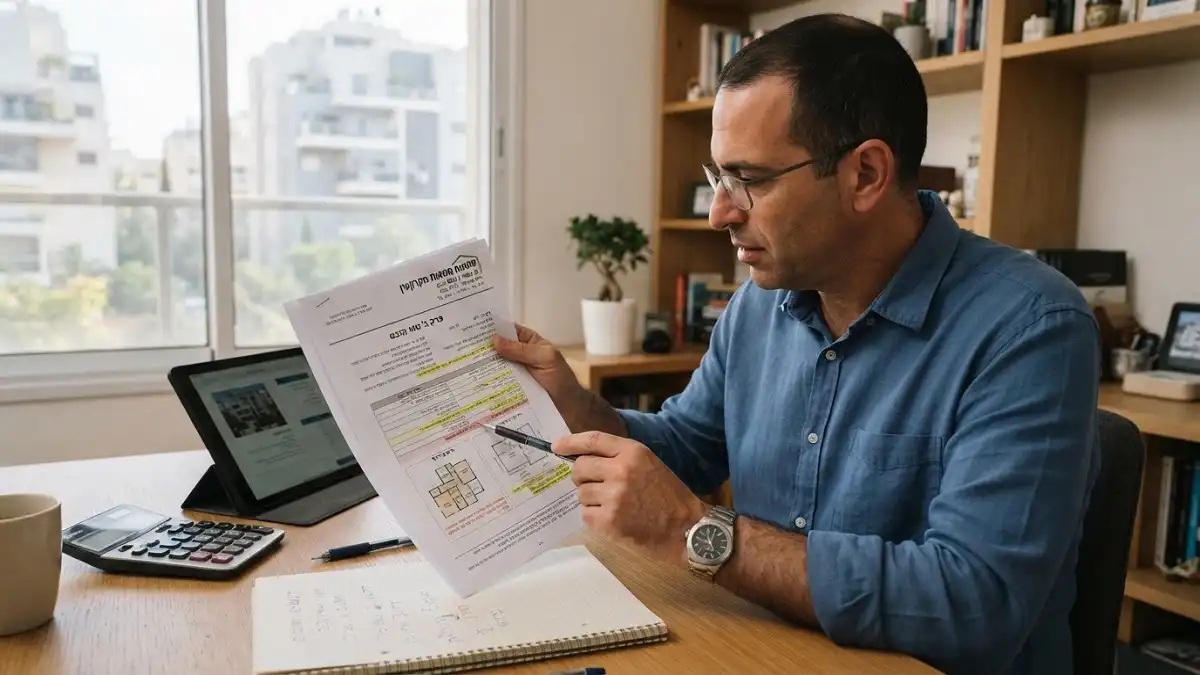
How to Read an Israeli Property Appraisal Report: A Strategic Guide for Buyers and Investors in 2026
Most buyers skim the appraisal, sign the mortgage paperwork, and hope the numbers hold. That habit costs money. Learning how to read an Israeli property appraisal report gives you leverage the seller does not expect, because the document exposes legal defects, size discrepancies, and building-rights gaps that marketing language hides.
At Chicagoland Business Broker, our valuation work spans business sales and real estate integration, and the same discipline applies here: the report is a negotiation tool, not a formality.
An Israeli appraisal (“Shumma”) is prepared by a licensed appraiser (שמאי מקרקעין) and drives your bank’s loan-to-value calculation.
Read it well and you can challenge the asking price with evidence. Read it poorly and you may overpay or lose financing you assumed was secure.
Key Takeaways
- The appraisal value, not the contract price, often determines your mortgage. Banks lend against the lower of the two.
- Registered size (Tabu) frequently differs from advertised size. That gap alone can shift value by tens of thousands of shekels.
- “Building potential” is worthless unless the report confirms enforceable rights. Assume nothing the appraiser has not verified.
Report Overview and Definitions
The appraisal is a structured valuation document, not a home inspection. It tells you what the property is worth, what limits its value, and what risks may affect it later. Our hands-on deal analysis suggests buyers who treat each section as a checklist catch problems early.
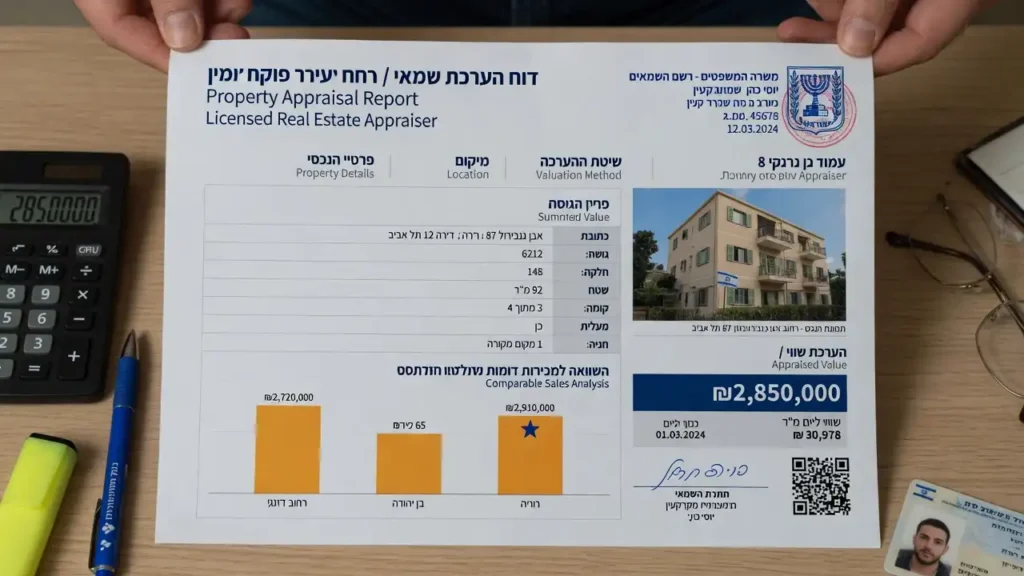
A standard report contains these components:
| Section | What It Tells You | Why It Matters |
|---|---|---|
| Property identity | Address, Gush/Helka (block/parcel), unit description | Confirms you are valuing the correct asset |
| Legal status | Ownership type and registered rights | Affects financing and marketability |
| Market value | Appraiser’s estimated value in NIS | Sets your mortgage ceiling |
| Comparable sales (“Hashva’ot”) | Recent transactions, usually 3+ | Justifies the value figure |
| Restrictions | TAMA, heritage limits, easements | Caps renovation and expansion |
| Engineering notes | Limited condition observations | Flags moisture, cracks, age |
Two dates and one measurement deserve attention:
- Report date (“Yom Shuma”): Banks reject outdated reports. Confirm it is current.
- Valuation basis: Current market, forced sale, post-renovation, or with planning potential. These are not interchangeable.
- Property size: Registered (Tabu) size versus measured size. A difference here is common and material.
For a section-by-section walkthrough of the document itself, this guide on how to read an Israeli property appraisal report covers the structure in detail.
Legal Framework and Ownership Types
Israel’s valuation profession is regulated by the government’s Real Estate Valuation Division. Only licensed appraisers may produce reports that banks and courts accept. You can review the regulator’s role through the Israeli Land Appraisal Department.
Ownership type changes value and financing more than most buyers realize. The report should state which system applies.
| Ownership Type | Description | Financing Impact |
|---|---|---|
| Tabu (freehold) | Full registered ownership | Cleanest for mortgage approval |
| Minhal / ILA lease | Long-term state land lease | Short remaining terms may reduce or block financing |
| Hevra Meshakenet | Housing company registration | Slower verification, added diligence |
Legal misreading is one of the most frequent and expensive buyer mistakes. Watch for these:
- Square meters that include unregistered or illegal additions
- Balcony or roof rights that are partial, not full
- Minhal lease expiry dates that lenders treat as risk
- Extensions lacking a Form 4 completion certificate
When the marketing says “full roof rights” but the report says “partial usage,” believe the report.
Financial Impact and Valuation Factors
The financial section decides price fairness and mortgage size. Read the adjustments carefully, because this is where value is added and subtracted.
The appraiser starts with a base value per square meter, then adjusts:
| Factor | Direction | Typical Weight |
|---|---|---|
| Floor level and elevator | + or – | Moderate |
| Parking and storage | + | Moderate to high |
| Direction and sunlight | + | Low to moderate |
| Building age and condition | – | Moderate to high |
| Illegal construction | – | High |
| Noise or commercial proximity | – | Moderate to high |
Misreading these adjustments leads to predictable losses:
- Overpaying by tens or hundreds of thousands of shekels
- Misjudging your mortgage-to-value ratio
- Expecting appreciation in a declining neighborhood
- Trusting a developer’s price without independent validation
Chicagoland dealmakers are noting the same pattern we see across markets: comparable sales carry the argument. If the three comps are recent, local, and truly similar, the value holds. If they are stale or from the wrong zone, the number is soft.
Building Rights and Planning Potential
Building rights are among the strongest value drivers, and the most misunderstood. Buyers assume “potential” is automatic. It is not.
The report should confirm whether these rights are enforceable:
- Whether the local plan (TABA) permits extensions
- Whether TAMA 38 or Pinui-Binui applies to the building
- Whether the unit’s land share supports redevelopment
- Whether the façade is restricted for heritage or environmental reasons
Here is the practical rule. When the appraisal states “no enforceable building rights,” you cannot price in future expansion. Knowing how to read an Israeli property appraisal report means separating confirmed rights from optimistic marketing.
Red Flags and Risk Indicators
Reports contain quiet warnings that inexperienced buyers pass over.
Each one can affect financing or future value.
| Red Flag | Possible Consequence |
|---|---|
| Illegal additions | Reduced valuation, mortgage limits |
| Pending objections or appeals | Planning uncertainty |
| Weak earthquake reinforcement | Renovation cost, Standard 413 concerns |
| Planned road or rail | Noise, expropriation, parking loss |
| Environmental zoning | Slower appreciation, limited liquidity |
| Moisture or structural cracks | Repair cost, price-reduction basis |
A single line such as “evidence of moisture in bedroom” can justify a meaningful discount. Do not skip the engineering notes because they are brief.
Mortgage Implications and Bank LTV Rules
Your loan is not calculated on the price you agreed. It is calculated on the appraisal. This distinction surprises buyers every week.
| Scenario | Bank Basis | Effect on You |
|---|---|---|
| Appraisal above price | Lower figure (the price) | No benefit from the higher value |
| Appraisal below price | Lower figure (the appraisal) | You supply the shortfall in equity |
| Legal defects noted | Reduced or conditional | Stricter LTV, added conditions |
| Short Minhal lease | Partial financing | May need more cash |
A worked example makes it clear. A 2.6M NIS Jerusalem apartment appraised at 2.25M NIS leaves the buyer to add roughly 350K NIS in equity. If you have not planned for that gap, the deal can stall at closing.
Negotiation Strategy Using the Appraisal
Once you understand the document, its weak points become your leverage. If you have been tracking Israeli property deals, this approach will feel familiar.
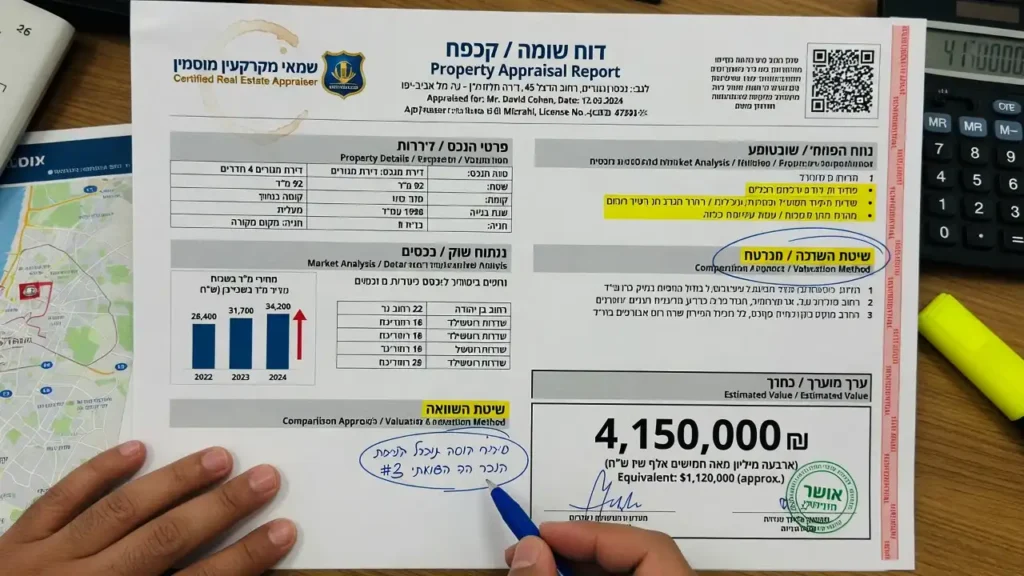
Use the report to:
- Identify price-inflating assumptions the appraiser rejected.
- Point to legal defects or uncertain rights.
- Emphasize deductions for condition, exposure, or noise.
- Cite comparable sales that contradict the asking price.
The outcome is realistic pricing or a clean exit. A buyer in Bat Yam reduced the price by 120K NIS after flagging non-registered balcony meters. The evidence did the work.
When to Request a Revised Appraisal
Sometimes the report itself is flawed. Requesting a correction is justified when the error changes your financing or negotiating position, and appraisers are obligated to fix factual mistakes.
Grounds for a revision include:
- Comparable sales from the wrong neighborhood or year
- Incorrect land registration data
- Missing TAMA 38 or building-rights potential
- Measurement errors from outdated municipal records
Knowing how to read an Israeli property appraisal report includes knowing when to push back. A well-supported challenge protects your loan amount and your leverage.
Conclusion
The Israeli market carries multiple ownership systems, uneven municipal records, planning restrictions, and seismic considerations. The appraisal is your map through that complexity, but only if you read every section with intent.
Learning how to read an Israeli property appraisal report helps you avoid inflated pricing, catch legal defects, and finance the deal you actually planned for.
At Chicagoland Business Broker, we apply the same valuation discipline to every transaction we support: verify the numbers, name the risks, and give you a realistic basis for the decision.
If you are weighing a purchase and want a second set of eyes on the figures, tell us where the deal stands and what the appraisal is showing.